
Tree Coffee Development in India
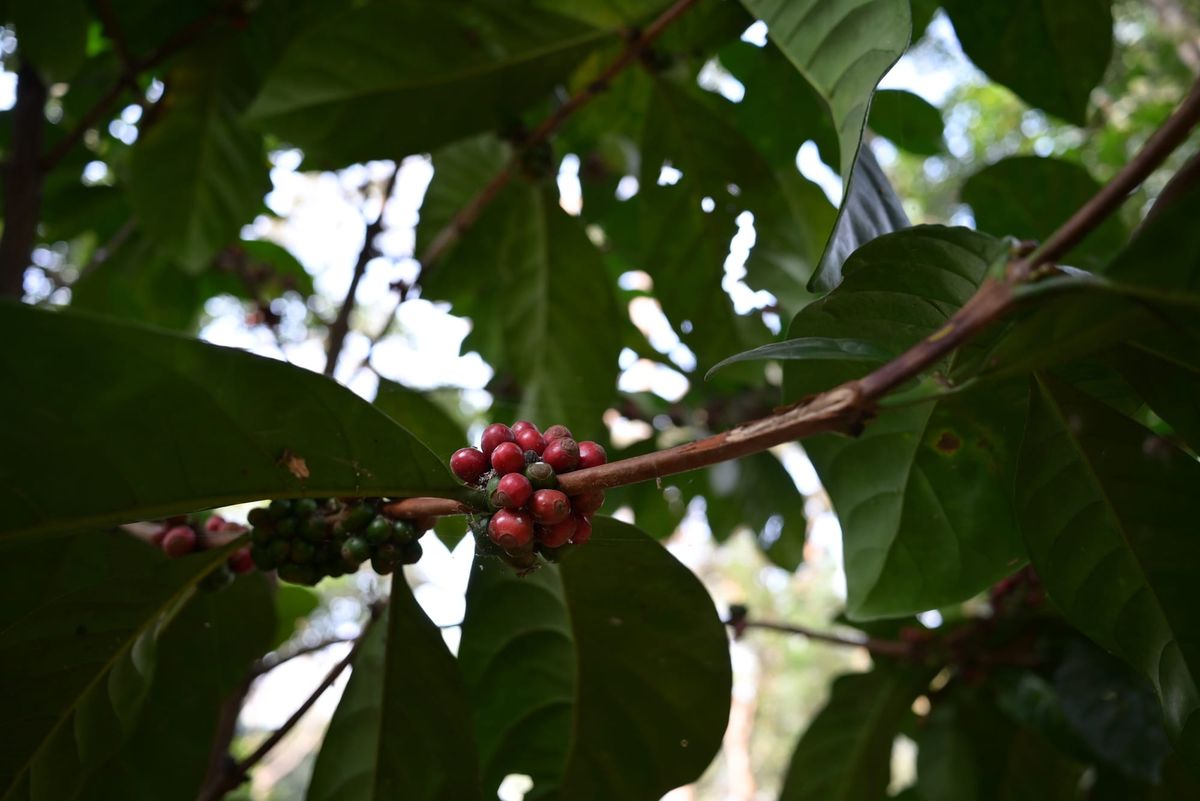
Excelsa, Liberica, Libex and the future of India’s Tree Coffee
Prepared by the team at SICC Labs, the research division of the South India Coffee Company.
Drawing on multi-generational farm observation, SICC sourcing data across Coorg, Hassan and Chikkamagaluru, and collaborative genomic research with Dr Aaron Davis and the team at the Royal Botanic Gardens, Kew.
For most of my life, the large coffee trees on our farm were simply part of the landscape.
They stood along fences, on boundaries, in the older sections of the estate, and in some cases within Arabica areas themselves. In India, almost everyone referred to this type of coffee as Liberica. It was the non-specific name given to what many farmers called Tree Coffee: large, vigorous coffee plants that were neither Arabica nor Robusta, and they were certainly not treated as specialty coffee. But my grandfather never referred to our Tree Coffee as Liberica; he called it Excelsa.
I grew up drinking that coffee from my early teenage years. At the time, I did not have the scientific understanding as to why that distinction mattered. It was just something my grandfather said with confidence: this was Excelsa, not Liberica. The trees were planted along fences, like many Asian producing countries, but on our farm they were not just boundary markers; my grandfather liked the coffee enough to plant it within Arabica blocks as well.
That detail, which once seemed like a family memory, has now become central to how I understand India’s Tree Coffee system. The more we have looked, across our farm, across Coorg, and into the Hassan District, the clearer it has become that India’s Tree Coffee story is not simply a Liberica story. It is largely an Excelsa-based story, and the interplay between two species that have been present for decades but never properly identified or categorised.
A longer history than the market remembers
India’s relationship with Liberica and Excelsa goes back much further than the current wave of interest in coffee species other than Arabica and Robusta. In the late nineteenth century, South Indian coffee growers were already under pressure from two problems that still define coffee farming in India today: coffee leaf rust and white stem borer.
In an article in the 1897 Mysore Gazetteer the leaf rust disease is identified as the fungal pathogen Hemileia vastatrix, and its ability to completely strip trees of foliage, causing the eventual death of the coffee tree. Damage caused by the larvae of Xylotrechus is also discussed, a beetle that bores into the stem and heartwood of coffee plants. In the same section, the article records that Liberian coffee (Coffea liberica) was introduced by Colonel Benson around the time when leaf rust disease was causing widespread destruction, because this taller, stronger plant from hotter and lower regions was thought to be more resistant to these pests and diseases [1].
That historical article is important for two reasons. First, it shows that Tree Coffee in India was not an accidental curiosity. It entered the farming environment as a resilience crop. Growers were already looking for coffee that could withstand what Arabica could not. Second, the same article notes that Liberian coffee was not a successful replacement, because of quality issues and other factors [2], but adds something remarkable: a hybrid, a cross between Liberica and Arabica, was said to be more promising [1]. Those lines seem almost prophetic now.
More than a century later, we are again asking whether Tree Coffee, and specifically Excelsa, Liberica and hybrids including these species, can become part of India’s answer to climate stress, pest pressure, and the need for low-intervention farming systems.
Why the old labels failed us
The problem is that, for most of this history, India did not distinguish these plants properly. Across farms, Liberica became a catch-all. Whether the plant was true Liberica, Excelsa, or a hybrid between these two species, it was usually grouped under the same name. Farmers recognised visible differences, but there was no market or institutional system that required more precision.
In practice, Tree Coffee was rarely developed as a crop. It was planted as a boundary marker, for pest control, a windbreak, a shade component, a hardy secondary crop, or sometimes simply as a legacy plant inherited from older estate systems. Many trees were allowed to grow tall, sometimes to over 30 feet (10 meters). In some farms, almost no selection was done; in others, growers made more deliberate seed selections, and those blocks now appear more homogeneous. This is why many of India’s Tree Coffee populations look semi-wild. They are cultivated but not properly selected, propagated, standardized, or pruned in the way Arabica and Robusta have been. And yet, hidden within that unstructured system is enormous value.
What is Liberica?
The turning point for us came when we began working with Dr Aaron Davis and the team at the Royal Botanic Gardens, Kew. A selection of our own farm material was tested using analytical DNA technology. What we had long called Excelsa, and what my grandfather had insisted was Excelsa, was confirmed. That mattered deeply. Our generational farm observation turned into a scientifically supported reality.
Research led by Dr Davis has reshaped the scientific understanding of Liberica. In 2025, Davis and colleagues published genomic work showing that what had long been treated as one species, Coffea liberica, or colloquially Liberica, should be recognized as three distinct species: Coffea liberica (Liberica), C. dewevrei (Excelsa) and C. klainei [3]. The publication gave language to something Indian growers had not been able to articulate clearly: what we had been calling Liberica was not always Liberica. In many places it was Excelsa, and in some places, something more complex. This work also matters because Liberica and Excelsa differ in their climate requirements, key agronomic traits, and in the flavour of the coffee they produce, which influences where these coffees can be grown, their yield, farmer profitability, and where they might sit with consumers.
The Malleshwara hybrids
Until the above-mentioned research paper, my understanding of Liberica was mostly comparative, shaped by what I had seen at India’s Central Coffee Research Institute (CCRI). The first scientifically verified reference point came from my cousin’s farm, Hardoor, where material tested by Kew was identified as pure Liberica. That gave us a baseline against which the Excelsa-dominant material on our farm, and later the Malleshwara Hybrids in Ballupet, could be understood. But the real shift for us came through our work at the South India Coffee Company (SICC).
SICC primarily sources, processes, and manages logistics for specialty green coffee. We also grow a number of different coffee species, from the orthodox to the experimental, and undertake our own coffee research. Through our sourcing network, we come across plant material that we would never see if we looked only at our own farm. At Malleshwara Estate, near Ballupet in Hassan District, we found trees that immediately stood apart. They did not look like the Excelsa we knew. They did not look like Liberica either. The fruits were much larger than Excelsa, but they carried themselves in clusters like Excelsa. The skin and parchment were noticeably thicker than Excelsa, but thinner than Liberica. The leaves were also thinner. The plant architecture was different, too, to the extent that it could not simply be dismissed as variation.
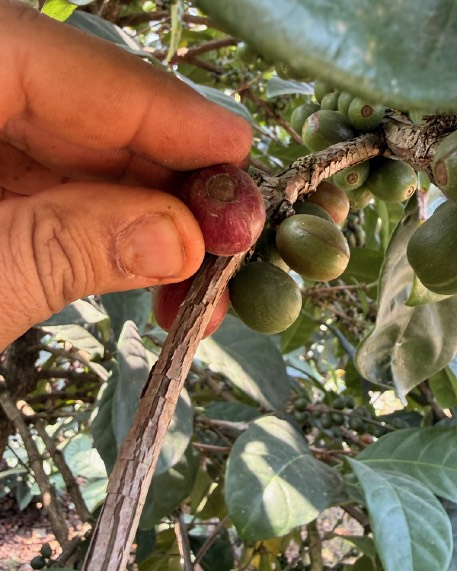
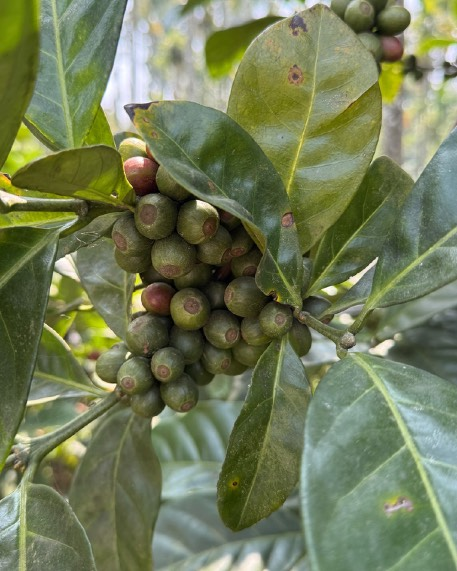
Libex at Malleshwara Estate, fruit noticeably larger than Excelsa, borne in Excelsa-like clusters.
Initial genetic testing at Kew showed that these plants were hybrids between Excelsa and Liberica. The trees had been planted around 1980 to 1982. That means these hybrids were not newly created. They had been standing in an Indian farm for four decades, unnamed. The revelation was not that India suddenly has these hybrids, or that they are not found elsewhere; it was that we were able to understand what they were. With this information we could then begin to understand their potential. We refer to this material as ‘Malleshwara’ because the name anchors the discovery to a place and an established coffee-growing family with a long and interesting coffee farming history.
A beneficial collaboration and a ‘new’ coffee
In a recently published study [4] DNA sequencing of 113 samples, over three continents, was used to elucidate and categorise hybrids between C. liberica and C. dewevrei (Liberica and Excelsa). The results show that these hybrids exist across the world’s coffee belt where these two species meet in cultivation, such as those found on the Malleshwara Estate in South India. These interspecies hybrids do not exist in the wild because their parental populations are separated by several hundred kilometers.
The DNA analysis methods employed not only enable hybrids to be recognised but also provide assessments of their genomic makeup, i.e. whether they have an equal or skewed genetic composition towards either parental species. These hybrids have been given the formal name of Coffea × libex but they can also be referred to simply as Libex coffee, or Libex. Importantly, the research by Davis et al. shows that these hybrids can be used for coffee crop development, to improve the yield and profitability of Liberica, and extend the range of climates where Excelsa-like and Liberica-like plants can be grown. Excelsa scores over Liberica for its agronomic traits [2,3] but Liberica may offer greater climate flexibility [5]. A recent review on the climate shows that Sarawak, located on the western side of the island of Borneo, has the highest known concentration of Libex, often mixed regionally and locally with pure Liberica.
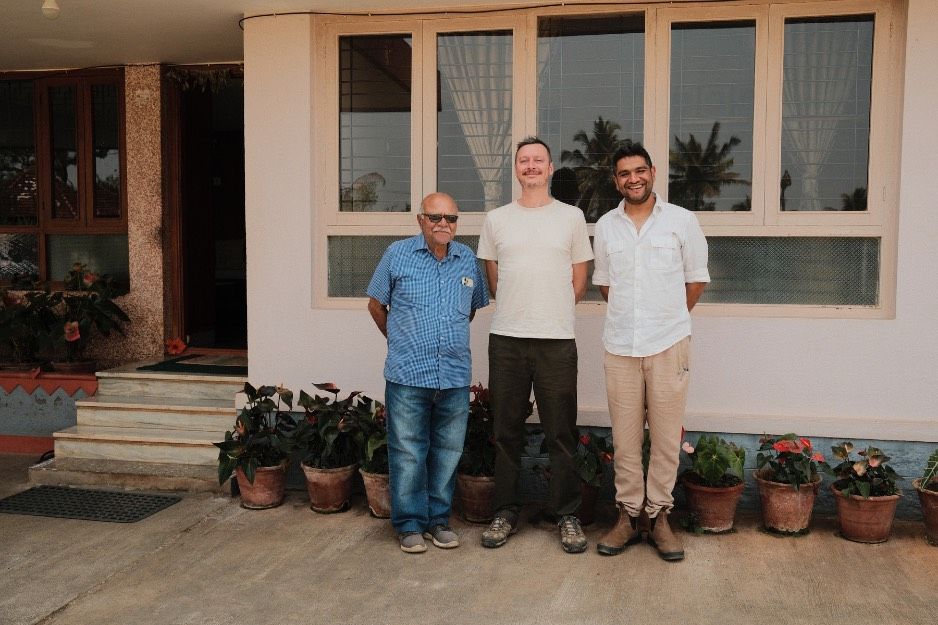
Mr. B. M. Mohan Kumar of Malleshwara Estate (left) with Matthew of Plot Roasting (centre), the first roaster in the UK to roast Libex; Akshay Dashrath from the South India Coffee Company team.
How India differs from Sarawak
With the data available so far, it is noteworthy that the Indian Libex differs from that found in Sarawak. The parental contribution of Sarawak Libex is dominated by Liberica, or is an almost equal mix of Liberica and Excelsa, whereas Indian Libex is dominated by Excelsa. Davis et al. [4] suggest that the hybrid bias for Excelsa might be because this species is more frequent than Liberica in India, and vice versa for Sarawak. Climate and environmental factors may also play a part, as the climate of coffee farms in South India is possibly more suited to Excelsa, and those of Sarawak to Liberica.
The DNA evidence backs up observations made in Coorg. Our sourcing and farm observations suggest that the Tree Coffee population is predominantly Excelsa, with potential later-generation hybrids. In Hassan, we see both Excelsa and Libex. We do not yet have enough data from Chikkamagaluru to make broad claims, but between Coorg and Hassan it seems safe to say that Excelsa is predominant. The Indian story must be understood through its own history, its own planting material, and its own regional ecology.
Why flavour matters
For a long time, Tree Coffee was discussed mainly in terms of resilience. But resilience alone is not enough. A crop can survive and still fail if the coffee is not accepted by the consumer: the ‘cup’ needs to represent an enjoyable drinking experience. This is where Excelsa and Libex become genuinely exciting. The cup is not merely acceptable. With the right material it is distinctive and commercially viable. Our Excelsa from Mooleh Manay shows a rich dried-fruit profile: prune, boysenberry, damson plum, with a syrupy body. It finishes clean with cocoa, orange zest, and toasted nuts, leaving a balanced and moderately persistent aftertaste.
Libex ‘Malleshwara’ moves differently in the cup, revealing floral fragrance, cherry-like fruit, orange rind, heavy body, and a round mouthfeel. The aftertaste is long. Compared to some Excelsa lots, it appears to retain the fruitiness while reducing the often-noted medicinal aftertaste that can make Indian Excelsa polarising. That is important. It suggests that Libex is not just useful for agronomic improvement and developing climate flexibility, but it may also be more accessible to the specialty market than Excelsa and Liberica. For me, this is where the possibility becomes real. A fertile, resilient hybrid is interesting to researchers. A fertile, resilient hybrid that is also palatable, and potentially beautiful in the cup, is interesting to growers, buyers, roasters and consumers. Davis et al. [4] also posit that it should be possible to transfer coffee leaf rust resistance to Excelsa, which although does not seem to be a problem in India, coffee leaf rust has been reported on Excelsa in some countries.
Not a new coffee but a newly defined one
India has had Excelsa for more than a century, and Libex for several decades. It stood on our boundaries, marked our fences, and grew into trees because no one thought to maintain and manage it. It was harvested when convenient, processed when possible, and sold under the wrong name, but it was always there.
For me, this is personal. My grandfather’s insistence that we had Excelsa on our farm no longer feels like an anecdote. It feels like the beginning of a much larger correction. If we take this seriously, India’s Tree Coffee could become one of the country’s important contributions to the future of coffee. Not because it is rare, but because it is resilient, productive, regionally expressive, and has the potential to be extremely flavoursome and enjoyable.
The way forward is to stop placing Tree Coffee in the leftover category. It is time to build it deliberately and smartly. Libex represents an important building block in this journey.
References
1. Rice, B. Lewis. Mysore: A Gazetteer Compiled for Government. Revised edition. Westminster: Archibald Constable and Company, 1897. Available via Internet Archive.
2. Davis, A. P., Kiwuka, C., Faruk, A. et al. “The re-emergence of Liberica coffee as a major crop plant.” Nature Plants 8, 1322 to 1328 (2022). https://doi.org/10.1038/s41477-022-01309-5
3. Davis, A. P., Shepherd-Clowes, A., Cheek, M. et al. “Genomic data define species delimitation in Liberica coffee with implications for crop development and conservation.” Nature Plants 11, 1729 to 1738 (2025). https://doi.org/10.1038/s41477-025-02073-y
4. Davis, A. P., Shepherd-Clowes, A., Lee, K. W. T., Jitam, D. M., Clayre, A., Dashrath, A. & Viruel, J. “Genomic elucidation of hybridization between Liberica and excelsa coffee and its implications for coffee crop development.” Scientific Reports (2026). https://doi.org/10.1038/s41598-026-49305-5
5. Wild, I. M. J., Davis, A. P., Lee, K. W. T., & Moat, J. “Climate requirements for cultivated Liberica coffee (Coffea liberica) and consequences for its use and development as a crop species”. Plants, People, Planet, 1 to 14 (2026). https://doi.org/10.1002/ppp3.70183
Prepared by the team at SICC Labs, the research division of the South India Coffee Company. This note draws on field observation and SICC sourcing data alongside the collaborative genomic research conducted with the Royal Botanic Gardens, Kew, in which SICC Labs is a named co-author (Davis et al., Scientific Reports, 2026; reference 4). With thanks to Mr. B. M. Mohan Kumar of Malleshwara Estate