South India Coffee Company Co-Authors Landmark Study Defining a New Hybrid Coffee, Coffea × libex
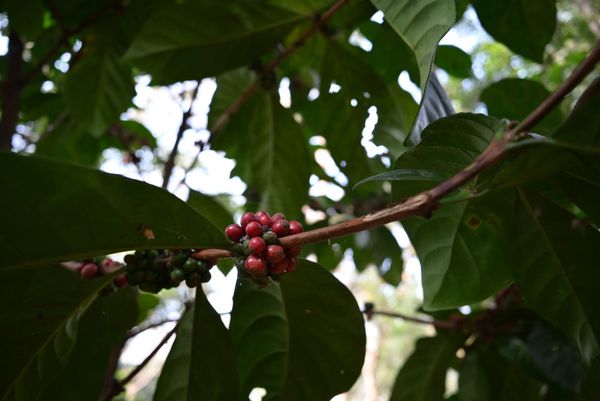
A newly identified coffee hybrid with implications for the development of coffee and its extension into unorthodox farming environments, published in Scientific Reports, with SICC Labs among the named authors and India’s Tree Coffee revealed as a distinct, Excelsa-dominant story.
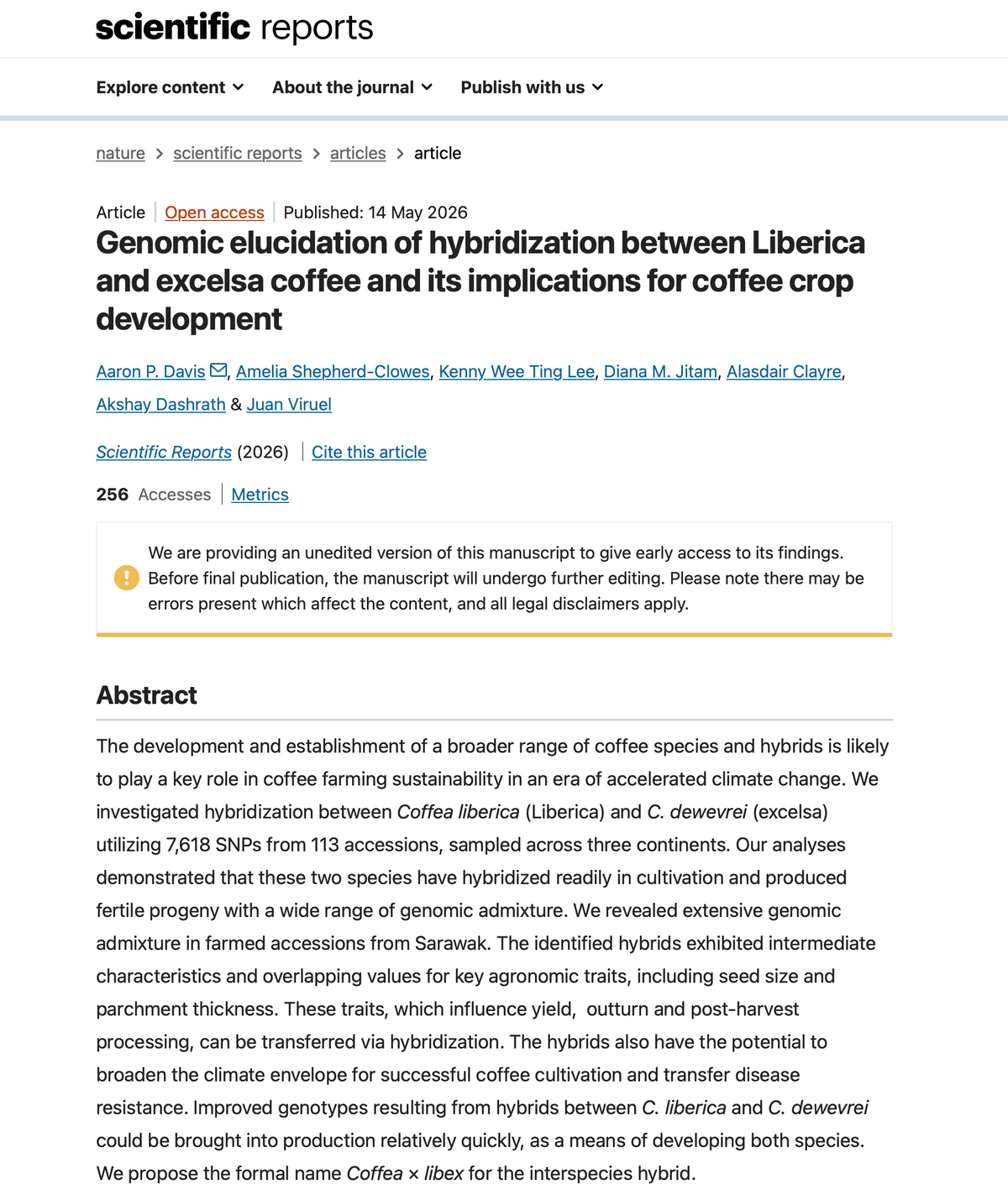
The South India Coffee Company (SICC), through its research division SICC Labs, is a named co-author of a new peer-reviewed study in Scientific Reports (Nature Portfolio) that uses genomic evidence to confirm and quantify hybridisation between two coffee species, Coffea liberica (Liberica) and C. dewevrei (Excelsa), and proposes the formal name Coffea × libex, known informally as Libex.
Led by Dr Aaron Davis and the team at the Royal Botanic Gardens, Kew, the study used 7,618 single nucleotide polymorphisms (SNPs) from 113 accessions sampled across three continents. The analyses demonstrate that Liberica and Excelsa have hybridised readily in cultivation, producing fertile plants with considerable genetic and physical diversity. Extensive hybridisation was found across farms in Sarawak, Malaysia, but the hybrids are also in cultivation elsewhere in Southeast Asia, Central America, Africa and India. The authors propose the formal botanical name Coffea × libex for the interspecies hybrid.
India’s contribution: a distinct, Excelsa-dominant story
SICC Labs contributed Indian accessions and field expertise to the international study, with the Suntikoppa-based company represented in the author list. Its material proved central to one of the paper’s most striking regional findings: where Sarawak’s Libex is biased towards Liberica, the Indian hybrids carry a substantially higher proportion of Excelsa, with nine Indian accessions showing Excelsa admixture of roughly 35% to 90%. This confirms with genomic evidence what SICC’s multi-generational farm observation and sourcing across Coorg, Hassan and Chikkamagaluru had long suggested: India’s ‘Tree Coffee’, for over a century grouped loosely under the name Liberica, is in fact largely an Excelsa-based system, with later-generation Libex hybrids.
Material from Malleshwara Estate near Ballupet in Hassan district, trees planted around 1980 to 1982 and confirmed by Kew as hybrids of Excelsa and Liberica, provided a key Indian reference point, alongside Excelsa-dominant material from Mooleh Manay.
Key outcomes of the study
As set out by the research team, the implications for the development of Liberica and Excelsa coffee are:
1. Liberica is a low-yielding coffee. Libex has improved yield and outturn over Liberica (outturn being the conversion of fresh fruit to coffee beans). Higher yield and outturn improve farmer profitability.
2. The thinner pulp and thinner parchment of Libex should improve post-harvest processing efficiency and coffee quality, compared with Liberica.
3. The smaller seeds of Libex, which can reach a similar size and shape to Arabica, make it more amenable to processing, roasting and grinding.
4. Liberica is resistant to coffee leaf rust, the worst coffee disease globally. Libex appears resistant too, as seen in Sarawak; rust resistance may thus be transferable to Excelsa via hybridisation with Liberica.
5. Liberica is climate-resilient and can be farmed where Arabica and Robusta cannot. Such resilience traits could be transferred to Excelsa to extend its farming range, and vice versa.
6. Liberica is unfamiliar and challenging in the cup for many drinkers; initial tests show Libex is more acceptable, offering a more balanced and recognisable coffee experience.
Why it matters for the future of coffee
Broadening the range of cultivated coffee species and hybrids is widely seen as essential to farming sustainability as climate change accelerates, with Arabica and Robusta accounting for more than 99.99% of global production and increasingly exposed to climate stress. The study shows Libex can be brought into production relatively quickly as a means of developing both Liberica and Excelsa, broadening the climate-farming envelope into areas where Arabica and Robusta would be difficult or impossible to grow.
Flavour is central to that promise, and India offers a clear illustration. SICC’s Excelsa from Mooleh Manay shows a rich dried-fruit profile: prune, boysenberry and damson plum with a syrupy body, finishing with cocoa, orange zest and toasted nuts. The Malleshwara hybrids move differently in the cup: floral, with cherry-like fruit, orange rind, a heavy body and a long, round finish, appearing to retain fruitiness while reducing the medicinal aftertaste that can make Indian Excelsa polarising, a profile the company believes is more accessible to the specialty market.
“For generations our family called this coffee Excelsa, not Liberica. The genomics now confirm what the farm always knew, and turn a century-old mislabelling into one of India’s real contributions to the future of coffee.”
Akshay Dashrath, SICC Labs
A collaboration across continents
The research brought together the Royal Botanic Gardens, Kew; SICC Labs in India; Earthlings Coffee and the Agricultural Research Centre Semonggok in Sarawak; the University of Malaysia Sarawak; and the University of Zaragoza. For SICC, the publication is a beginning rather than an endpoint, with classification and grading systems, genotype selection, multi-location trials and flavour research ahead, building India’s Tree Coffee deliberately rather than leaving it, as the company puts it, in the leftover category.
The publication can be found: https://www.nature.com/articles/s41598-026-49305-5
About the South India Coffee Company
The South India Coffee Company (SICC) sources, processes and manages logistics for specialty green coffee, alongside its own farming and research work. Its research division, SICC Labs, based in Suntikoppa, Kodagu District, Karnataka, focuses on the development of India’s Tree Coffee, Excelsa and Liber, combining multi-generational farm observation with collaborative genomic science.
Media contact
Komal Sable · SICC Labs, South India Coffee Company · contact@sicc.coffee · +919970198003
Suntikoppa, Kodagu District, Karnataka 571237, India · sicc.coffee
# # #
Notes to editors
• The study: Davis, A. P., Shepherd-Clowes, A., Lee, K. W. T., Jitam, D. M., Clayre, A., Dashrath, A. & Viruel, J. “Genomic elucidation of hybridization between Liberica and excelsa coffee and its implications for coffee crop development.” Scientific Reports (2026). https://doi.org/10.1038/s41598-026-49305-5
• SICC Labs (Suntikoppa, Kodagu District, Karnataka, India) is a named co-author institution; the study is open access under a Creative Commons Attribution 4.0 International licence.
• Method: 7,618 SNP markers across 113 accessions from three continents, analysed with STRUCTURE and Principal Coordinate Analysis, supported by morphological data on seed dimensions and parchment thickness.
• Naming: the hybrid is formally proposed as Coffea × libex, following conventions used for other interspecies coffee hybrids; a practical field guideline treats plants with more than ~10% Excelsa genetic contribution as Libex.
• Background: A. P. Davis et al., “Genomic data define species delimitation in Liberica coffee...” Nature Plants 11, 1729 to 1738 (2025), https://doi.org/10.1038/s41477-025-02073-y; “The re-emergence of Liberica coffee as a major crop plant...” Nature Plants 8, 1322 to 1328 (2022), https://doi.org/10.1038/s41477-022-01309-5; and Wild, I. M. J. et al., “Climate requirements for cultivated Liberica coffee...” Plants, People, Planet (2026), https://doi.org/10.1002/ppp3.70183.
• A companion SICC Labs research note, ‘Tree Coffee Development in India’, is available on request.